_underway_off_San_Francisco_on_9_February_1944_(19-N-60938).jpg) |  |  |  |  |
|---|---|---|---|---|
 |  |  |  |  |
 |  |  |  |  |
 |  |  |  |  |
 |  |  |  |  |
 |  |  |  |  |
 |  |  |  |  |
 |  |
Click on a picture in the gallery above to see a full resolution image, or to navigate manually. For more images, scroll down
USS England
DE-635
Pacific Ocean,1944
Why this ship?
What most people know about World War II at sea is about big battles where battleships, cruisers, and carriers had a go at each other. In reality, highly intense engagements involving small ships and boats were happening all the time, such as in the Atlantic convoys, the submarine campaign that gradually strangled Japan, and the brutal encounters between motor launches and torpedo boats in the English Channel. These more frequent, arguably less glamorous, but very intense events shaped history as much as the big sea battles.
To those in charge of allied naval strategy, it was clear from the very early days that winning the war would require "workhorse" ships that could be produced relatively quickly, and in large numbers, to sustain operations wherever the large fleet units could not be. This included, in particular, ships capable of chasing and sinking submarines. Enter the US industrial machine, and between late 1942 and the end of the war more than 500 Destroyer Escorts (hull designation DE) had been launched to cover this need. Among these more than 140 formed the Buckley class, which included England (named after Ensign John C. England, who died during the Pearl Harbor attack while saving several of his shipmates). The Buckleys were slower, smaller and less heavily armed in comparison with contemporary fleet destroyers, but did not lack in the antisubmarine department.
Despite the humble origins, England (DE-635) is on record for achieving a combat performance unlikely to be ever matched: the sinking of 6 submarines in 12 days. As with most things in war, this was not an individual performance, but team work. Nonetheless, England is emblematic of the thousands of small ships and boats that did a lot of the heavy lifting on both sides of the war.
What was added
The Trumpeter kit is really nice, and can yield an excellent model of a Buckley class destroyer out of the box. It includes options for full hull or waterline, and even has some photoetch parts (for the depth charge racks, radar, and a mast platform). Maybe I should have opted for a quick build, adding just some railing and rigging. I think this would have cut the build time from 5 months to 2. But that was not to be...
Trumpeter 1/350 USS England: the box contents
-
I used the Five Star models upgrade set, which is very extensive: six large sheets of photoetch, many resin parts, and metal parts for the guns. This set is in equal parts superb in quality, and frustrating. The biggest source of frustration are the instructions. They are just photos of what you are supposed to end up with, but make no attempt to tell you how to bend metal, where, or in which order. For example: I did manage to build something that resembles a 1.1" quad "Chicago piano", by joining nine different small pieces of photoetch, and 4 turned brass barrels. I am not 100% sure that this is what the creators of the set wanted me to do, but the results look close enough. But I was thoroughly defeated when trying to build the 20 mm Oerlikons, each of which (presumably) requiring 4 pieces of photoetch, and 2 turned brass parts. I just could not figure out what to do. The gallery below shows some examples of what the instructions look like.
The main materials used in building this model. Note that there is a lot of golden metal everywhere!
Click on a picture in the gallery above to see a full resolution image, or to navigate manually.
-
For the Oerlikons, having given up on the Five Star set, I ended up using 3D printed units from Bunker studios.
-
I used some resin parts sent by my Britmodeller friend Neil, spares from his build of HMS Rupert (a Royal Navy captain-class frigate; these were derived from Everts- and Buckley class DEs). This included some really nice searchlights and sky lookout chairs.
-
Rigging was done with a mix of Uschi and AK elastic line.
-
For the first time, I set this model in a resin base, trying to make it look like the ship was at anchor in a lagoon. This was done with generic two-part resin, to which I added a blue tint using alcohol based dye. More about that below.
Construction notes, including lessons learned
-
There were no dramas associated with the Trumpeter kit itself. It still requires a respectable amount of filling and sanding, particularly if you decide to do a full hull configuration - as per images below, this involved multiple cycles until a smooth transition could be achieved.
-
Keep in mind that all the engraved and raised detail you see in the plastic parts will need to be sanded off, to allow the photoetch surfaces to stick properly. I used Micro Krystal Klear to join the large photoetch surfaces to the plastic, and this worked well.
-
One of the frustrations derived from the decision to use the Five Star Models set is the fact that you have to deal with building many, many depth charge arbors, one by one. Each requires finding a suitably sized "stem" (not provided in the set), and gluing it individually to the "plate" (provided in the set). Then, you have to insert each arbor into a rack glued to a vertical surface (each requiring 2 bends in the metal). I used leftover supports from 3D printed resin parts for the stems. At least an entire week was dedicated to this step.
Left: a small sample of the tedious task of building depth charge arbors. Right: Examples of the racks where you have to secure the arbors, here shown festooning the aft 3" platform.
-
Another repetitive task: each depth charge has to be made individually. For each, find some plastic rod (I used Evergreen), and glue 2 metal circles (provided by Five Star models) to the ends. Heads up: there are not enough metal parts to make all depth charges you would need to fill all the racks, so some will be left partially empty (you decide which).
Building tiny depth charges and using them to fill the racks will be another test of anyone's patience.
-
Another repetitive task: each depth charge has to be made individually. For each, find some plastic rod (I used Evergreen), and glue 2 metal circles (provided by Five Star models) to the ends. Heads up: there are not enough metal parts to make all depth charges you would need to fill all the racks, so some will be left partially empty (you decide which).
-
Painting was fairly straightforward. Following Mr. Surfacer 1000, the main colour used for vertical surfaces was Mr. Color 14 (Navy Blue; close enough to 5-N) and for horizontal surfaces was Mr. Color 375 (JADSF Deep Ocean Blue; close enough to Deck Blue 20-B). As I learned, even the radar and antennas were painted 5-N blue in Measure 21 (see here).
-
The real challenge was to make the model look a bit more interesting, considering that everything was dark blue. To try to counteract that, a few things were done:
-
Some spraying with very diluted SMS Pru Blue (PL73), was used to lighten the hull a bit in some places, trying not to be too systematic.
-
Selected parts were lightly sprayed or brush painted with PL73 other tones of dark blue (e.g. Tamiya XF-17 Sea Blue, or XF-50 Field Blue), or even extra dark sea grey. The idea was to create some variations, without breaking the camouflage rules.
-
Some impression of rust was created by applying a wash made from very diluted Tamiya hull red (XF-9) with a paintbrush, and allowing it to run along crevices and surface joints.
-
The hull was treated with some (hopefully) random-looking "streaks" created with XF-9, XF-17, and XF-50 washes, to add the variations seen in contemporary pictures (see here).
-
-
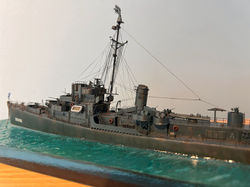
The sea scape was meant to show England taking a well deserved break in an idyllic blue lagoon. The historical records indicate that this is at least possible, as she visited a resupply base in Palau between the sub-sinking bonanza in May 1944 and being crashed on by a Japanese dive bomber in May 1945. Because she is represented at anchor, flags are being flown from the jackstaff and flagstaff (the latter had to be made from tungsten wire). The final colour of the blue surface is result of some light tinting of the resin (see below), followed by painting the surface with diluted blue acrylic, clear green, and clear blue.
And a few more pictures...
Click on a picture in the gallery above to see a full resolution image, or to navigate manually


.jpeg)


Construction photos

Steps in the construction of the 1/350 USS England DE-635.

Steps in the construction of the 1/350 USS England DE-635.

Steps in the construction of the 1/350 USS England DE-635.
Steps in the construction of the 1/350 USS England DE-635.